
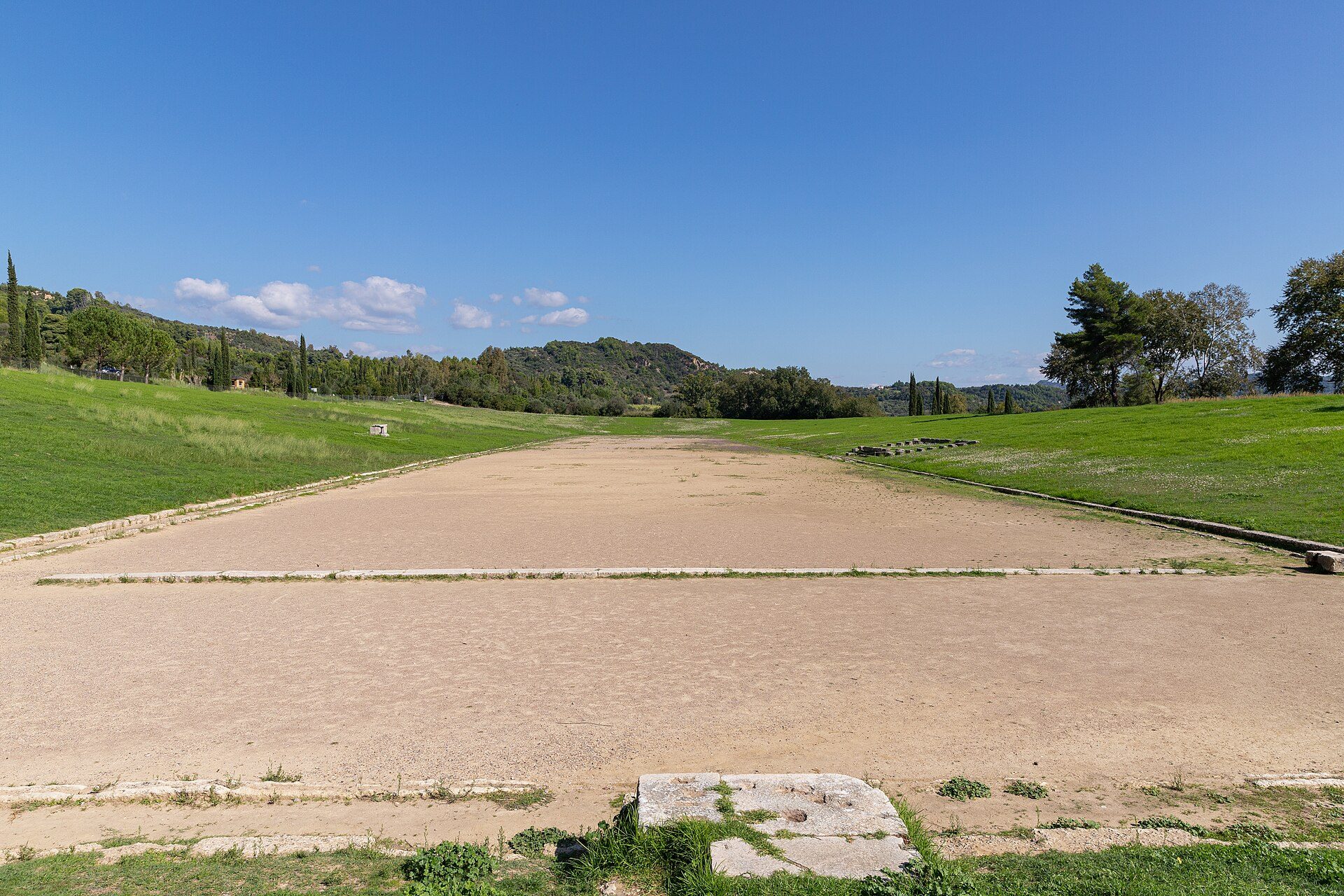
Olympic Stadium
Olympic Stadium Guide — Ancient Olympia
Sprint barefoot on the same earthen track where ancient athletes competed for sacred olive wreaths — the emotional heart of any Olympia visit.
Distance
35 km from Katakolon pier to Olympia stadium
Travel time
35–45 min by coach each way
Time needed
25–35 min at stadium; 2–3 hours for full Olympia site
The stadium at Ancient Olympia is not a reconstruction or a modern arena wearing antique makeup. It is the actual competition ground used for centuries of ancient Olympic foot races, with a stone starting sill (balbis) and a vaulted entrance tunnel that still frames the track exactly as athletes experienced it. Reached via a 35–45 minute drive from Katakolon, the stadium sits within the wider archaeological park and typically anchors the first or final segment of a ruins walk.
Ancient stadiums were practical, not ornamental. Olympia's course measures roughly 192 metres — the origin of the Olympic 'stadion' unit — with earthen banks where spectators stood or sat on grassy slopes rather than marble tiers. You enter through the Krypte, a stone-vaulted passage that once separated competitors from the roar of the crowd. Emerging onto the track, most visitors instinctively walk to the starting line and place their feet in the carved grooves. It is one of the rare archaeological moments that requires no explanatory plaque to land emotionally.
Foot races — stadion, diaulos and dolichos — dominated early Olympic programmes before chariot racing expanded the games. Athletes competed nude after oiling their bodies, a tradition tied to Greek ideals of physical perfection and divine offering. Women had separate festivals at Olympia but were largely barred from this stadium during the main games. Knowing that context transforms a simple photo stop into a encounter with how ancient Greeks understood honour, religion and bodily excellence.
For cruise passengers, the stadium is the non-negotiable sight within Olympia. Budget 25–35 minutes here if crowds are moderate; longer if you want photographs without strangers in frame. Morning light inside the tunnel is softer than midday glare on the open track. Combine the stadium with the nearby Temple of Hera and Philippeion on a looping path, then head to the museum when outdoor temperatures climb. Summer heat on the exposed track is intense — visit before 11:00 when your tour schedule allows.
How to get there
| Method | Detail | Time | Cost |
|---|---|---|---|
| Within Olympia ruins walk | Reached on foot from main archaeological entrance | 10–15 min walk from gate | Included in site ticket |
| Guided shore excursion | Coaches drop at site; guides lead stadium circuit | 35–45 min from Katakolon | Excursion price |
| Private tour | Flexible arrival time — aim for early slot | 40–50 min from port | €120–200+ |
| From museum side | Some routes approach stadium from eastern paths | 5–10 min walk | Site ticket |
Stadium visit within a typical Olympia morning
| Time | Activity | Notes |
|---|---|---|
| 0:00 | Enter archaeological site | Ticket check at main gate |
| 0:15 | Walk toward stadium via sacred precinct | Guide context en route |
| 0:25 | Krypte tunnel and starting line | Peak photo window |
| 0:55 | Continue to Temple of Zeus area | Logical loop progression |
| 1:30 | Philippeion and surrounding ruins | Shade varies by season |
| 2:00 | Move toward museum as heat builds | Air-conditioned break |
Stadium vs other Olympia priorities on tight timing
| Sight | Skip if rushed? | Reason |
|---|---|---|
| Olympic Stadium | Never skip | Defining experience |
| Temple of Zeus | Brief visit only | Ruins still impress quickly |
| Archaeological Museum | Trim to 30 min | Sacrifice depth, not entirely |
| Bouleuterion | Skip | Secondary civic building |
| Workshop ruins | Skip | For repeat visitors |
Experiencing the stadium — guided vs self-paced
| Approach | Pros | Cons |
|---|---|---|
| Licensed guide | Rich athletic and religious context | Paced to group |
| Audio guide | Flexible timing | Less narrative colour |
| Independent walk | Freedom to linger at starting line | Easy to miss context |
| Small-group tour | Balance of depth and photo time | Premium price |
Did you know?
Photography tips
- Shoot from inside the Krypte tunnel toward the track for the classic symmetrical frame.
- Low angles on the starting grooves emphasise the carved stone texture.
- Mid-morning light reduces harsh shadows on the earthen banks.
- Wide shots from the far end of the track capture the stadium's human scale.
Highlights
- Krypte vaulted entrance tunnel
- Original stone starting line (balbis)
- Earthen track used for ancient foot races
- Grass banks where spectators gathered
- Views toward the Altis sacred precinct
Tips for cruise passengers
- Wear grippy shoes — the track is earth and can be dusty or slippery after rain
- Arrive early to photograph the tunnel without tour groups inside
- Respect roped areas — erosion control limits some bank access
- Pair stadium visit with Temple of Hera nearby
- Carry water — no shade on the track itself
Return-to-ship confidence
The stadium sits mid-visit within Olympia — it does not add separate transfer time. Your return confidence depends on the overall excursion schedule. Allow 35–45 minutes drive back to Katakolon plus standard pre-all-aboard buffer.
Prefer a guided tour?
Olympia Small Group Tour
Ancient Olympia with room to ask questions — a compact group, a dedicated guide, and no coach-tour anonymity.
Essential Katakolon cruise planning
Ancient Olympia from Katakolon
Walk where the Olympic flame was first lit — the Peloponnese sanctuary that makes Katakolon one of the Mediterranean's most meaningful cruise calls.
Temple of Zeus Guide — Ancient Olympia
Once home to one of the Seven Wonders — colossal gold-and-ivory Zeus watched over every ancient Olympic Games from this Doric sanctuary.
Archaeological Museum of Olympia — Visitor Guide
The sculptures that once crowned the Temple of Zeus and the masterpieces too fragile for open air now live in one of Greece's finest regional museums.
House of the Olympic Games — Visitor Guide
Modern storytelling meets ancient tradition — interactive exhibits bridge the stadium ruins and the Olympic Games the world watches today.
Need help choosing?
Tell us your ship and interests
We match Katakolon shore excursions to your port window with honest return-to-ship advice — Ancient Olympia, village and Peloponnese food.
Olympic Stadium Guide — Ancient Olympia — FAQs
Can you run on the ancient Olympic track?▼
Visitors commonly jog or sprint short distances on the earthen surface. Be mindful of dust, heat and other guests. It is not a formal event track — treat it respectfully as an archaeological site.
How long should I spend at the stadium?▼
Twenty-five to thirty-five minutes is typical — enough for the tunnel, starting line and photographs. History enthusiasts may linger longer; rushed six-hour port itineraries may compress to fifteen minutes.
Is the stadium accessible for visitors with mobility issues?▼
The track surface is uneven earth with some slopes on the banks. The tunnel has a gradual incline. Many visitors with moderate mobility manage with assistance; wheelchairs are challenging on the track itself.
Where is the stadium within Ancient Olympia?▼
On the eastern side of the archaeological park, approached through the sacred Altis precinct. Your guide or site map routes you there after entry from the main gate.
Is the stadium included in the standard Olympia ticket?▼
Yes — it lies within the archaeological zone covered by the main site entrance. No separate ticket is required beyond the ruins pass or combined ruins-museum ticket.
What is the best season to photograph the stadium?▼
April–May and September–October offer softer light and milder temperatures. Summer visits work if scheduled before 11:00; midday sun creates harsh contrast on the open track.